What Does a Full Blood Test Check For? The Common UK Tests
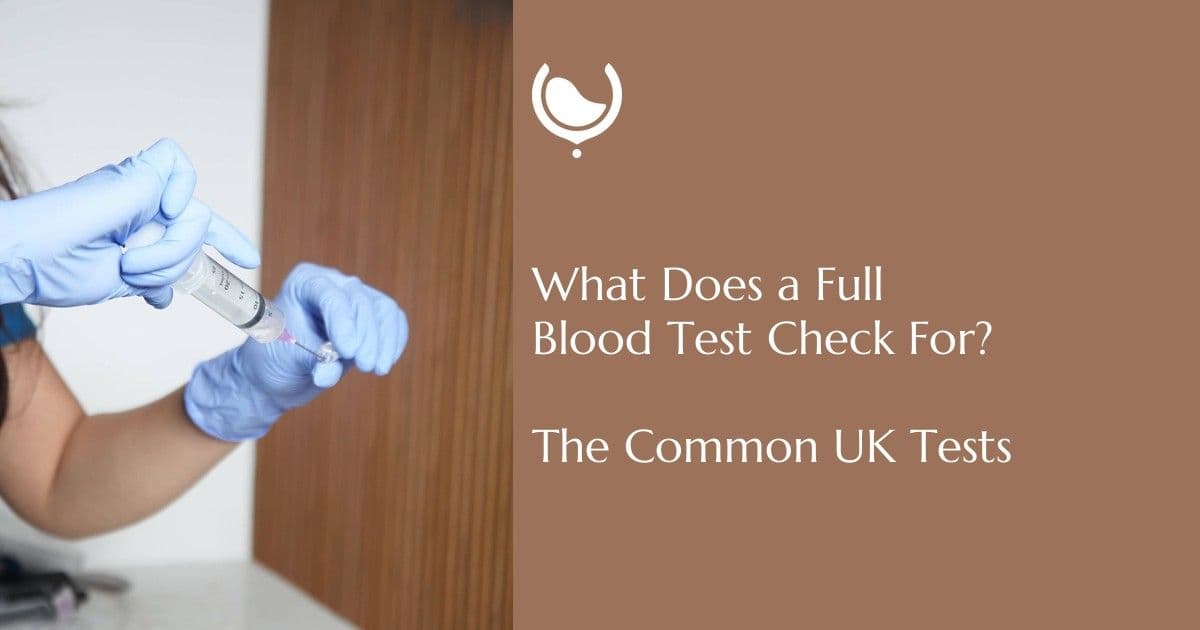


"Full blood test" is not the name of a single test: the NHS website lists blood tests individually, among them the full blood count (the number of blood cells), blood glucose, urea and electrolytes, the lipid profile (cholesterol) and thyroid-stimulating hormone (TSH)1. Which tests are done depends on your symptoms, any conditions you have and any medicines you take1. The NHS Health Check for adults aged 40 to 74, for example, includes a cholesterol test and possibly a blood sugar test2, and our own profiles list their markers in advance.
Below are the common building blocks, what each one measures, how far the reference ranges printed by NHS laboratories differ for four of them, and what our profiles list. A result outside a range does not necessarily indicate disease3, and a GP or the clinician who requested the test can explain a result in the context of your health. This is general information, not advice on any individual result.
The building blocks of a full blood test
The NHS website names six common types of blood test, and the profiles that laboratories and providers list add further markers. The six are the full blood count, blood glucose, urea and electrolytes (the renal panel), the lipid profile, total protein and thyroid-stimulating hormone (TSH)1.
This guide covers these building blocks, drawn from the NHS list and from the markers in our own profiles:
- Full blood count (FBC): red cells, white cells and platelets
- Urea and electrolytes (U&E): the kidney function test
- Liver function tests (LFTs)
- Thyroid function: TSH and thyroxine (T4)
- Lipids: cholesterol and related fats
- Glucose, or HbA1c
- Inflammation markers: CRP and ESR
- Iron studies and ferritin
- Vitamin B12 and folate
- Vitamin D
Shorthand such as "LFTs" stands for a set of markers. At Severn Pathology (North Bristol NHS Trust), for example, the liver function profile reports albumin, ALP, ALT and bilirubin, with total protein requested separately4.
What each common test measures
Each common test measures a different thing in the blood. One plain line on each:
- Full blood count. Counts the red cells that carry oxygen using haemoglobin, the white cells that are part of the immune system, and the platelets that help blood to clot5.
- Urea and electrolytes. At Severn Pathology the profile reports urea, sodium, potassium and creatinine, listed under renal function4.
- Liver function tests. Measure enzymes, proteins and other substances produced by the liver6.
- Thyroid function. When an underactive thyroid is suspected, the NHS describes blood tests to check how much TSH and thyroxine (T4) is in the blood7.
- Lipids. The lipid profile measures cholesterol levels1.
- Glucose and HbA1c. Blood glucose measures blood sugar levels1. HbA1c reflects the average blood glucose level over the previous two to three months8.
- CRP and ESR. CRP is a protein that rises in response to inflammation9. ESR measures how quickly red blood cells settle in a sample, an indirect measure of inflammation10.
- Iron studies and ferritin. An iron panel measures substances such as serum iron, ferritin and transferrin11. Our guide to what counts as a low ferritin level in the UK covers ferritin on its own.
- Vitamin B12 and folate. The blood test measures the levels of these two B vitamins in the bloodstream12.
- Vitamin D. The test measures the level of vitamin D in the body13. The NHS advice on vitamin D in autumn and winter is set out in a separate guide.
How much NHS laboratory ranges differ
NHS laboratories print different reference ranges for the same test: across 10 services the lowest haemoglobin counted as normal for women runs from 115 to 120 g/L, and across 12 services the upper limit for TSH runs from 4.2 to 5.6 mIU/L. We read each laboratory's published figures in October 2026; they are listed in the sources. Ten services print haemoglobin, white cell count and platelet ranges and twelve print a TSH range, and together they cover England, Scotland and Northern Ireland. Laboratories take their ranges from different sources: University Hospitals of North Midlands, for example, derives its TSH range from the analyser manufacturer's instructions3.
Examples of the spread, as printed:
- Haemoglobin, g/L. Severn Pathology: women 120 to 150, men 130 to 1704. Bath15 and Belfast16 print the same figures. Cornwall: women 118 to 148, men 133 to 167, with no unit printed17. Gloucestershire: women 115 to 165, men 130 to 18018. Cambridge, ages 18 to 65: women 120 to 156, men 135 to 17219.
- White cell count, x10^9/L. Gloucestershire 3.6 to 11.018. Sussex 4.0 to 10.020. Black Country 4.5 to 13.021. Cornwall prints separate ranges: men 3.7 to 9.5, women 3.9 to 11.117.
- Platelets, x10^9/L. Cambridge 150 to 37019. Gloucestershire 140 to 40018. Sussex 150 to 41020. Newcastle 150 to 45022.
- TSH, mIU/L (some services print mU/L). University Hospitals of North Midlands 0.1 to 53. Gloucestershire and York 0.27 to 4.218, 14. Newcastle 0.3 to 4.522. Birmingham 0.4 to 4.923. Oxford 0.35 to 4.9424. Severn Pathology 0.38 to 5.334. Edinburgh 0.23 to 5.625.
Across the 10 services with full blood count figures, and the 12 with a TSH figure, the limits run:
- Haemoglobin, women: lower limit 115 to 120 g/L, upper limit 148 to 165 g/L
- Haemoglobin, men: lower limit 130 to 135 g/L, upper limit 167 to 180 g/L
- White cell count: lower limit 3.6 to 4.5, upper limit 9.5 to 13.0
- Platelets: lower limit 140 or 150, upper limit 370 to 450
- TSH: lower limit 0.1 to 0.4, upper limit 4.2 to 5.6
The same number can therefore sit inside one laboratory's range and outside another's. As arithmetic about ranges, not a comment on any person's result: a haemoglobin of 118 g/L is inside the printed range for women at 6 of the 10 services and below it at the other 4, and a TSH of 4.6 mIU/L is inside the printed range at 7 of the 12 services and above it at the other 5. Laboratories also split by sex and age: all 10 print separate haemoglobin ranges for women and men, and Cambridge prints different ranges from age 65.
One NHS laboratory puts it this way: results outside the reference range "do not necessarily indicate disease", and results within it "do not preclude abnormality"3. The range printed on your own report comes from the laboratory that ran your sample, and a GP can explain it5.
What the NHS routinely checks
The NHS chooses blood tests for a reason, and the NHS Health Check for adults aged 40 to 74 includes a cholesterol test and possibly a blood sugar test.1, 2 The NHS describes blood tests as done to check your general health, to find out whether symptoms are caused by a condition, and to see how well a condition is being managed1.
The NHS Health Check is a free check-up of heart and blood vessel health. People aged 40 to 74 without certain existing conditions should be invited by their GP or local council every 5 years2. The check takes about 20 to 30 minutes and usually includes measuring height, weight and waist, a blood pressure test, a cholesterol test and possibly a blood sugar level test2.
The blood test profiles at our clinic
Our clinic lists seven blood test profiles and a G6PD test, each with its markers named in advance. The blood testing page describes a complimentary nurse consultation, a doctor consultation as an alternative, and results within 24 to 48 hours. The profiles are:
- Essential Blood Profile: FBC, LFTs, kidney, bone, lipids, iron studies, glucose
- Well Woman Profile: FBC, ESR, LFTs, kidney, bone, lipids, iron studies, glucose, TSH, FT4, ferritin, CRP, B12, folate, vitamin D
- Well Man Profile: the same list as the Well Woman Profile, plus PSA
- Vitamin Profile: vitamin B1, B2, B6, B9, B12, vitamin C and vitamin D
- Mineral Profile: calcium, magnesium, selenium, zinc, iron, copper, chromium, manganese
- Heavy Metal Profile: lead, cadmium, aluminium, mercury
- Hormone Profile: FSH, prolactin, LH, LH/FSH ratio, oestradiol, progesterone, SHBG, testosterone
- G6PD: a single test
The Well Woman and Well Man lists name each of the building blocks above, with glucose listed rather than HbA1c. The profile names and markers, the walk-in appointments and the consultation options are set out on the page for blood testing at our Mayfair clinic.
Common questions
Do I need to fast before a blood test?
Only for some tests: the NHS says that before certain blood tests you may need to avoid food and drink other than water for a short time, and that most people do not need to fast for a cholesterol test.1, 26 The GP, nurse or specialist arranging the test should tell you if you need to prepare in any way1. For a cholesterol test the NHS says you might be asked not to eat for up to 12 hours beforehand, but most people do not need to fast26.
How long do NHS blood test results take?
The NHS says you may get blood test results after a few days, and usually within a few weeks.1 For a cholesterol test with blood taken from the arm, it says the result should arrive in a few days26. If you hear nothing after a few weeks, the NHS advises contacting the GP surgery or specialist1.
Can a blood test find everything?
No: each blood test checks specific things, and which ones are used depends on your symptoms, any conditions you have and any medicines you take.1 The NHS says that if your results do not show anything you may not need to do anything else, and that you may sometimes need other tests, depending on why you had the blood test1. It advises asking a healthcare professional if you have questions about a result or do not understand it1.
Sources
- Blood tests, NHS, reviewed 2023
- NHS Health Check, NHS, reviewed 2023
- TSH, University Hospitals of North Midlands NHS Trust, viewed October 2026
- Severn Pathology, North Bristol NHS Trust, test information, viewed October 2026: haemoglobin, white blood count, platelet count, thyroid function tests, liver function tests, urea and electrolytes
- Full blood count (FBC), Lab Tests Online UK, 2026
- Liver blood tests, Lab Tests Online UK, 2021
- Underactive thyroid (hypothyroidism), NHS, 2025
- HbA1c test, Lab Tests Online UK, 2024
- C-reactive protein (CRP), Lab Tests Online UK, 2018
- Erythrocyte sedimentation rate (ESR), Lab Tests Online UK, 2022
- Iron tests, Lab Tests Online UK, 2019
- Vitamin B12 and folate, Lab Tests Online UK, 2023
- Vitamin D, Lab Tests Online UK, 2026
- York and Scarborough Teaching Hospitals NHS Foundation Trust, viewed October 2026: thyroid stimulating hormone
- Royal United Hospitals Bath NHS Foundation Trust Pathology Services, viewed October 2026: full blood count and TSH
- Belfast Health and Social Care Trust, 2026: haematology and blood bank laboratory user manual and clinical biochemistry user manual.pdf)
- Full blood count, Royal Cornwall Hospitals NHS Trust Pathology Service, 2026
- Full blood count (FBC), Gloucestershire Hospitals NHS Foundation Trust, 2025 and thyroid function tests, 2026
- Haematology tests, Cambridge University Hospitals NHS Foundation Trust, viewed October 2026
- FBC, University Hospitals Sussex NHS Foundation Trust Pathology, 2022 and TFT, 2026
- Full blood count (FBC), Black Country Pathology Services, viewed October 2026 and thyroid stimulating hormone
- Newcastle Hospitals laboratories, 2025: haemoglobin, white blood count, platelet count and TSH
- Thyroid-stimulating hormone (TSH), University Hospitals Birmingham NHS Foundation Trust, 2026
- Thyroid stimulating hormone, Oxford University Hospitals NHS Foundation Trust, 2026
- Edinburgh and Lothians Laboratory Medicine, NHS Lothian, viewed October 2026: full blood count and thyroid stimulating hormone
- Getting tested for high cholesterol, NHS, 2026
Related Treatments